WasteMate is an independent service and is not affiliated with any council. Always confirm local rules with your council. Report an error.
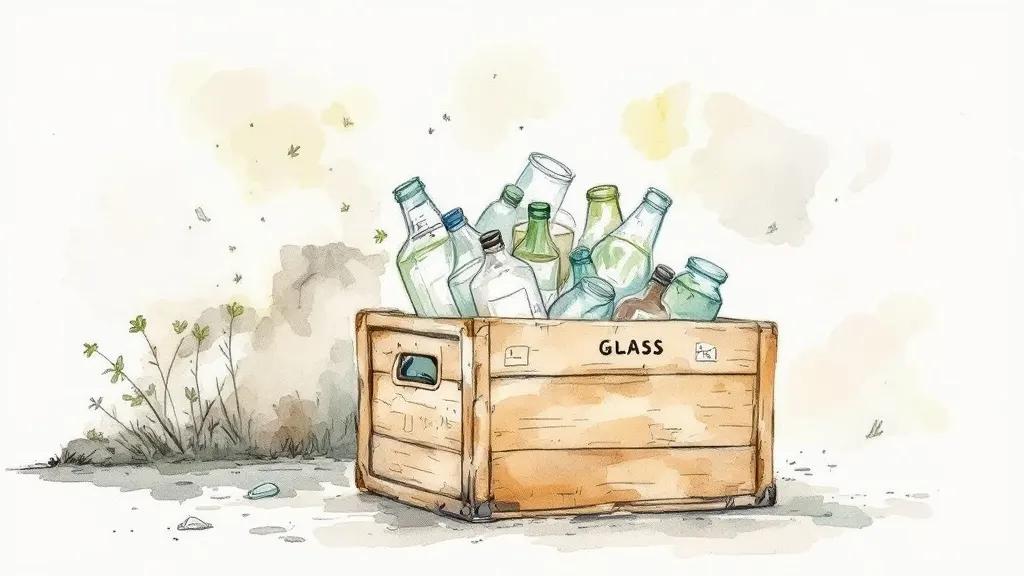
Glass Recycling in New Zealand: Why It Goes in a Separate Crate
If you've noticed your council handing out a small crate just for glass, you might wonder why it can't simply go in the yellow recycling bin with everything else. The answer comes down to quality. When glass is collected mixed in with paper, cardboard and plastics, it tends to break during collection and transport. Those tiny shards then contaminate the other materials — embedding in cardboard and clinging to plastics — which lowers the value of the whole load and can send otherwise recyclable material to landfill. Keeping glass separate keeps both the glass and everything else cleaner and more useful.
Glass is one of the genuine success stories of recycling because it can be melted down and remade into new bottles and jars over and over again with no loss of quality. New Zealand has its own glass manufacturing capability, which means clean, separated glass collected at the kerbside can be turned back into local containers rather than shipped overseas or downcycled. That closed loop only works well when the glass arrives unbroken and free of other rubbish, which is exactly what the separate crate is designed to achieve.
So what actually belongs in the glass crate? Glass bottles and jars — think wine and beer bottles, pasta sauce jars, jam jars and condiment bottles. Give them a quick rinse so leftover food and liquid don't attract pests or create odours, and take all lids and caps off the jar or bottle and put them in your general waste — lids and caps are not accepted in kerbside recycling anywhere in New Zealand, regardless of material. You don't need to remove paper labels; these burn off during the melting process. Different colours of glass are generally fine to mix in the crate, as they're sorted later.
Just as important is knowing what does not belong. Drinking glasses, window glass, mirrors, Pyrex and other ovenware, light bulbs and ceramics are all made differently from container glass and have a different melting point. Even a small amount can ruin a whole batch, so keep these out of the crate entirely. Broken drinking glasses, crockery and window panes should go in your general waste, wrapped safely so they don't injure collection staff. Light bulbs and fluorescent tubes may need special handling — check whether your local transfer station or community recycling centre accepts them.
Rules do vary around the country. Most councils that use the standardised system collect glass in a crate separate from the yellow bin, but collection days, crate sizes and exactly what's accepted can differ from place to place. Some areas still take glass in the yellow bin, while others rely on drop-off points. If you're unsure, a quick look at your local council website will tell you the local setup.
The takeaway is simple: that separate crate isn't a hassle, it's the reason glass recycling actually works. Rinse your bottles and jars, leave out drinking glasses and ceramics, and keep glass apart from your other recycling. It's a small habit that helps keep New Zealand's recycling clean, valuable and genuinely circular.
Where to take it in New Zealand
Find sites and drop-off points near you that handle the items covered in this guide.
Find glass recycling drop-off points